Fluss+ vs remote fobs and tags: what changes when access control moves to the cloud
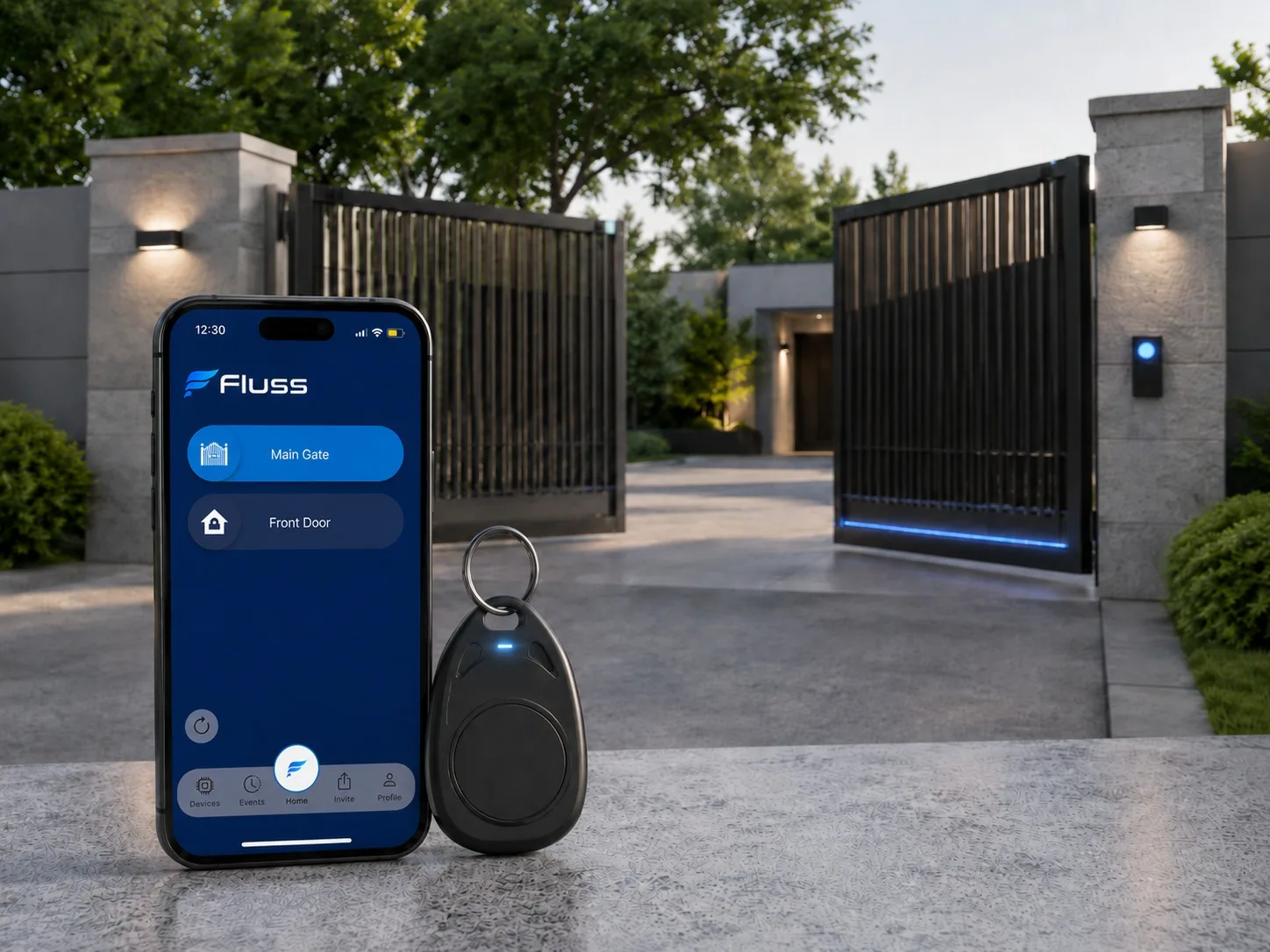
Almost every gate, boom, and door in the field is opened by a remote fob on a keyring or an RFID tag held to a reader. Both work. They're also the reason so many properties can't answer a simple question — who opened the gate at 2am on Sunday?
A fob is a bearer token, not an identity
A fob or tag proves one thing: someone at the entrance is holding a valid object. It says nothing about who they are. The gate can't tell the resident from whoever found the fob in a car park, because the decision is made about the credential, not the person.
Fluss+ inverts this. The credential is the user account, so every open is attributed to a named person, and every rule applies to that person — not to a piece of plastic you hope is in the right pocket.
Lost, lent, and cloned
When a fob goes missing you either issue a replacement while the old one keeps working, or re-enrol the whole site. Most properties choose the first, so the population of live credentials only ever grows. Cloning makes it worse: the 125 kHz tags on a large share of installations copy in seconds with a cheap off-the-shelf duplicator, and the reader can't tell the copy from the original.
A cloud credential has nothing physical to find, borrow, or clone — and revoking it is one tap in the dashboard.
Revocation is the part fobs simply can't do
The contractor finished the job. The tenant moved out. The cleaner left on bad terms. You can ask for the fob back, but you can't enforce it — and until it's in your hand, the property is open to someone you no longer have a relationship with.
You can revoke a database record. You cannot revoke an object that somebody else is holding.
Access has a time dimension. Fobs don't.
A fob either opens the gate forever or not at all. Real buildings need conditional access: cleaners on Tuesday mornings, contractors this week only, a visitor code that works once and expires. With a tag, that gets handled socially — a fob lent out and hopefully returned. With Fluss+ it's a setting: scheduled access windows, plus one-time or time-limited guest codes sent by SMS, WhatsApp, or email. Granting access to a new tenant is a message, not a courier run.
Every open becomes a record
Conventional receivers log little or nothing, so investigating an incident means scrubbing camera footage by hand. Because Fluss+ decisions happen in the cloud, the audit trail is a by-product of normal operation: who opened what and when, exportable for compliance, with real-time notifications on the events you care about.
Access becomes programmable
A fob can't talk to anything. An access point managed in software can be driven by the systems you already run: self-storage that grants access when rent is paid and locks out when it isn't, short-term rentals issuing a code per booking that expires at checkout. That's what the Fluss API and webhooks make possible once the gate is addressable.
Side by side
| Question | Remote fob or RFID tag | Fluss+ |
|---|---|---|
| Who opened it? | The credential is known; the person isn't | A named user, on every event |
| Someone loses it | Replace it — the old one still works | Revoke it in the dashboard; nothing to recover |
| Cloning | 125 kHz tags copy in seconds | Account-based credentials, encrypted end to end |
| Granting access | Program and hand over a physical object | Send a link or code by SMS, WhatsApp, or email |
| Time-limited access | Not expressible | Schedules, plus one-time and expiring codes |
| Audit trail | Little or none | Full cloud log, exportable, real-time alerts |
| Range | A few metres, and a battery | From anywhere — or Bluetooth at the gate |
| Talking to other systems | No | REST API and webhooks |
| Security updates | A site visit, if possible at all | Automatic over the air |
Where fobs and tags still make sense
One honest advantage remains: a fob asks nothing of the user. No phone, no app, no account — and in a high-throughput lane, a windscreen tag is hard to beat. Guest links close much of that gap, but not all of it.
Connectivity, though, isn't the trade-off it looks like. Fluss+ also opens over Bluetooth, phone to device, so it keeps working when the Wi‑Fi is down — and once a user has accepted their invite, they don't need mobile data at the gate either.
Nor is it an either-or decision. Fluss+ wires into the same dry contact terminals your gate motor, boom, or strike already uses, so existing receivers and readers stay where they are. Most properties run both: fobs keep working while residents move to the app at their own pace.
The takeaway
Fobs solve a narrow problem — opening a gate without getting out of the car — and solve it well. But managing access at a modern property is a problem of identity, time, revocation, audit, and integration, and a bearer token can't express any of those.
If you're weighing an upgrade, read our take on the hidden cost of legacy access control, or go straight to how Fluss+ works and the pricing.