QR vs NFC for access and sharing: which should you choose?
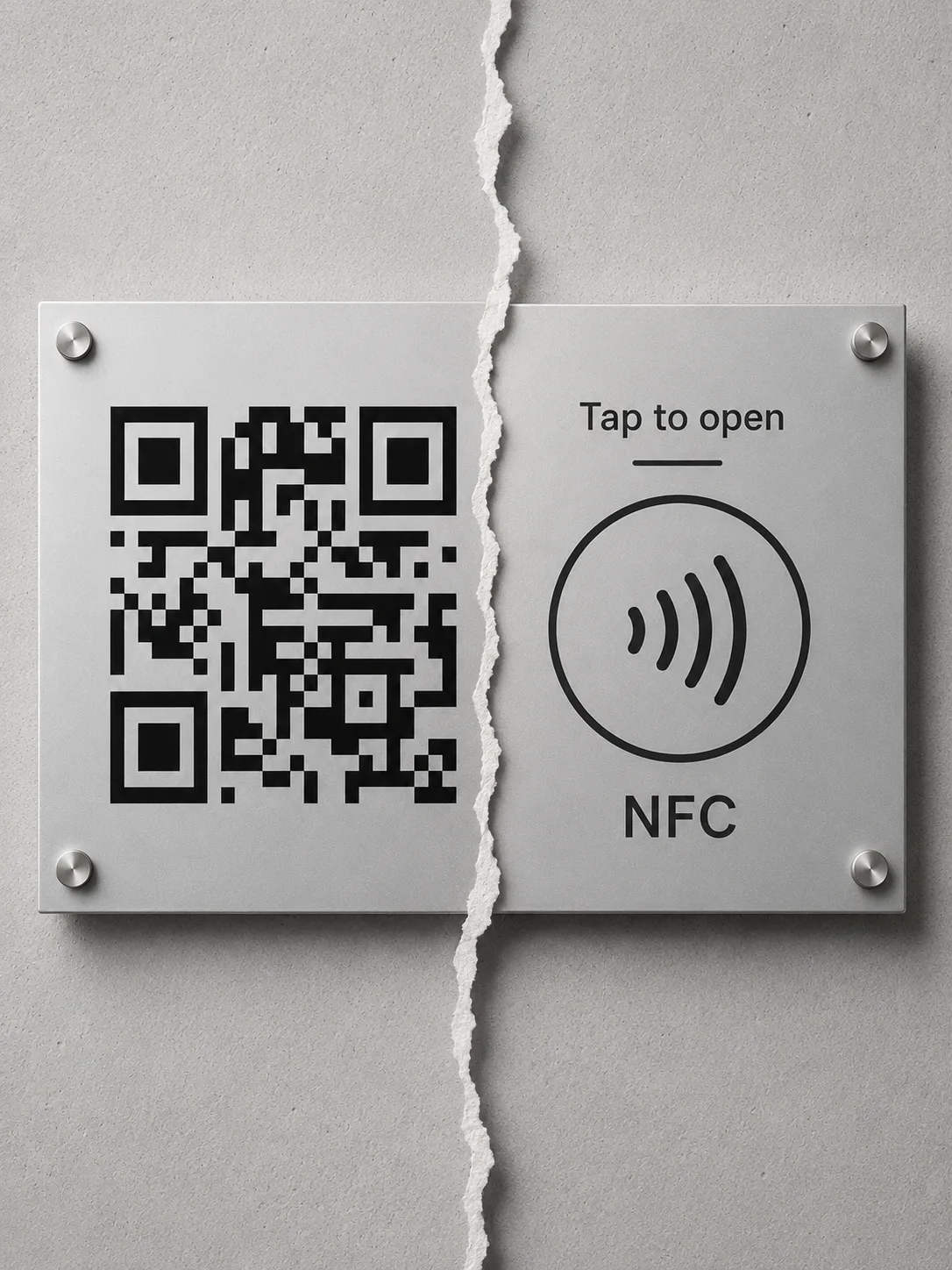
QR codes and NFC are the two most common ways to connect a physical object to a digital action — opening a door, loading a profile, sharing a contact. They look interchangeable, but the right choice depends on cost, hardware, and how people will actually use it.
How they differ
A QR code is just an image. It costs nothing to produce, works with any phone camera, and needs no power or electronics at the point of contact. The trade-off is that the user has to open a camera, frame the code, and tap a link.
NFC is a short-range radio chip. A tap is faster and feels more premium, and there's nothing to scan — but every tag carries a unit cost, the phone must support NFC, and the chip has to be physically present in the object.
Cost and durability
QR wins decisively on cost: a printed code is effectively free and can be reproduced infinitely. It's also immune to electronic failure — there's nothing to break. NFC adds a per-unit cost and a physical component, though a well-embedded tag is robust and tamper-resistant.
User experience
For a first-time visitor, a QR code is the safer bet — everyone knows how to point a camera, and there's no compatibility question. For repeat, high-frequency interactions, NFC's single-tap flow is hard to beat. The best products often offer both, letting the user pick whichever is closest to hand.
The strongest designs don't pick a side — they put a QR code and an NFC tag on the same object and let the moment decide.
How we use both at Fluss
Our QR video intercom is built entirely around a printed code: a visitor scans the board at the entrance, picks a resident, and starts a video call — no power, no electronics, nothing to fail at the gate. By contrast, Touchshare, a digital business card we designed and built, carries both an NFC chip and a QR code on the same card, so you can tap or scan to load and exchange contact details.
Choosing for your project
Default to QR when cost, reach, and zero-maintenance matter most. Reach for NFC when speed and a premium tap experience justify the per-unit cost — and when you're not sure, consider doing both. If you're weighing the options for a connected product, our team can help you spec it; start with the IoT Builder.